The robots have arrived. But should you rely on them to write your business copy?
Find out immediately. Jump to the reasons for and against.
Elsewhere in the article
- My view on AI copywriting
- A summary of what it is and how it works
- How to make AI copy part of your content marketing.
The adoption of ChatGPT by everyone from Ryan Reynolds to Liquid Death, and huge media companies such as News Corp, has made it mainstream.
You’re probably drowning in messages about your business’ potential professional relationship with artificial intelligence (AI), and how you should use it to:
- maximize your marketing efforts
- save yourself a shitload of time
- hold on to a tidy amount of your marketing budget.
But damn, it’s a lot to wrap your head around.
And it’s not that you’re not interested.
A few of your business buddies have given it a spin, and they’re finding some success with it.
But are they giving you the complete picture?
Like you, I have a single-owner, service-based business.
And I’m all about being totally transparent. (I specialize in that long-game marketing strategy called SEO, so I have to be.)
So, having used AI copywriting tools for some of my business copy, here’s my review.
They can be good. But achieving good takes work and requires thoughtful, conscious use.

My view on AI copywriting tools has changed. I used to think they were crap and not worth any of my work time. I’ll share why I used to feel that way and my reasons for softening in a moment. But for those of you just dipping your toes into the AI ocean, let’s first look at
- some of the more popular ones.
- what these copywriting tools are capable of
- how they work
A quick summary of AI copywriting
An AI copy generator is the result of combining machine learning (a robot) with natural language processing (NLP) software.
I think it brings an element of cuteness to an otherwise terrifying reality of creating something that knows ev-rey-thing.
I like to picture it as The Terminator sitting in a junior school classroom, with every piece of written text in history laid out on a tiny desk in front of him.

In reality, an AI copy generator scrapes existing internet content, and then analyzes the writing patterns, styles, and language to generate copy based on the prompts it’s been given.
As I’m writing this, the most coherent ones are the famed ChatGPT, Jasper AI, Copy.ai, and Claude.
Businesses have been using AI to generate copy for all sorts of marketing communications – from website copy and product descriptions to blog posts to sales emails.
But should they?
Ad campaign concept brought to life using AI, for a fraction of the cost.
6 drawbacks to using an AI copywriter
Getting copy in an instant is a really appealing idea.
And I’m willing to try anything that can give my business a positive boost.
But when it comes to AI, I just can’t accept the “It’ll replace people writing copy” line.
And here’s why.
1. Prompting is time consuming
One of the biggest arguments for using AI-generated copy is that it will save you time.
But from personal experience that hasn’t been the case.
Just getting the prompts right is hard, partly because we’re using these tools to fix the problem of not knowing what to write.
Senior copywriter Glenn Murray’s comment in his AI copywriting article sums it up nicely:
“I’ve been a copywriter for 21 years, and I’ve worked with about a thousand clients. And not a single one of them was even able to articulate what they wanted, let alone what needed to be said in order to achieve that outcome. (Indeed, most couldn’t even articulate kinda what they wanted!)”
This has often been my experience as well, which is why I work with a (very human) copywriter.
Getting my ideas out of my head and onto the briefing form isn’t always easy.
That’s why I rely on the copywriter. I need them to prompt me.
“I’ve worked with about a thousand clients. And not a single one of them was even able to articulate what they wanted.” – Glenn Murray, senior copywriter
When I started experimenting with AI copy bots, I quickly realized that getting lengthy pieces of copy out of them (such as blog posts) isn’t an option.
Generating simple email subject lines is more promising.
But it still takes me 15-20 minutes to get anything remotely close to what I want.
And even then I end up cutting and chopping the suggestions because there isn’t a single one I like.
To get close to it being the miracle time-saving tool we’ve been led to believe, it needs a ton of information. (In some cases, that’s a 30-page briefing document.) Only after I’d created a Brand Blueprint did I start getting remotely close to copy that would work for my business.
For transparency, it took me 6-8 hours to create my blueprint, but now I have it, it’s saving me at least 4 hours each week on content creation.
2. There’s little room for feedback
Working with a copywriter is a collaborative process.
The copy almost always needs to be tweaked.
Whether it’s swapping a single word, restructuring the piece, or cutting whole paragraphs, there’s always something.
Explaining this to my copywriter takes half an hour at most.
I highlight the bit I don’t like, leave a comment, and then put it in their capable hands to fix.
Getting a bot to understand the changes I want isn’t so simple.
To give the best copywriting feedback, it’s important to sit on the copy for a few days and read it multiple times.
But more often than not the bot has moved on by the time I’m ready to give my feedback, whereas my copywriter still has my project front of mind.
This makes it easier (and quicker) to provide comments and get the copy I want.
3. The copy looks ugly
Readability affects the user’s experience, making it an indirect ranking factor.
And when these AI copywriters first landed, they didn’t seem interested in making their copy easy to read.
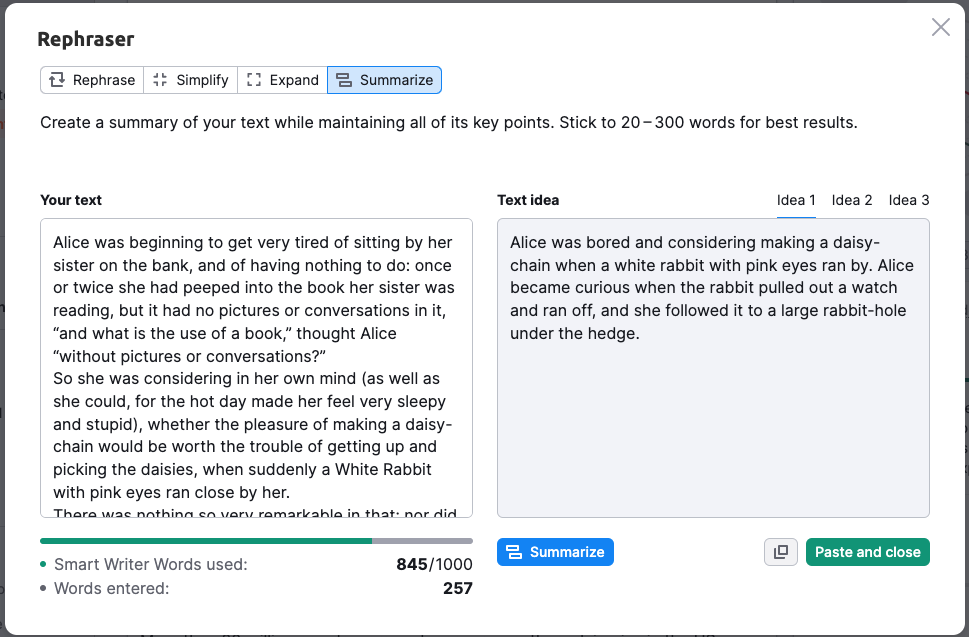
Horrendously long sentences, titles that always include a damn colon, and formulaic prose made the copy hard to digest.
The bots may not have to breathe or look at the copy, but we do!
Of course you’d format the copy before you serve it up to your clients.
But that’s another step you have to take, and one a copywriter or editor can handle for you immediately (usually without you even needing to ask).
Here’s an example originally used in an SEMrush article (that’s since been updated) but shows the kinda stuff we used to get.
But there has been progress.
As mentioned, if you give the bot a good amount of data to work with and tell it what you want (including readability features) you’ll get a decent result.
I find Claude is pretty great at this.
Note: Readability features include dot points, short paragraphs, rhetorical questions, etc.
4. Everyone’s a fan
Okay, maybe not everyone.
But a lot of marketers and businesses are using ChatGPT and its counterparts.
And so it won’t take long for AI-generated copy to become very samey, very boring, and very easy to spot.
Part of the problem is that AI copywriters can only scrape what already exists. Their ‘new’ copy is a rehash of what’s already out there.
For example, if you want a blog post about 10 Ways to Recycle Unicorn Poop and ask AI to write it for you, AI won’t come up with anything new. There’s no original thought. Ultimately, your article will look like everyone else’s.
In marketing that’s commoditizing. And that is a business no-no.
Although further change and disruption may be coming
At the time of writing, a number of leading media outlets, including USA Today, BuzzFeed, Quora, and AdWeek, have committed to blocking their content from AI.
By stopping AI machines from scraping their content, they’re protecting their publication rights.
For anti-AI advocates, this is a positive step. For those using AI to write their copy, it could serve as a warning.
If more trusted and reliable outlets take this route, the amount of quality information LLMs can scrape from will decrease.
Inevitably, the number of viewpoints it can draw from will decrease too, increasing the risk of bias and misinformation.
I’m not saying everything humans do is always original.
But our ability to be exposed to new experiences allows us to think about topics and subjects in ways that robots simply can’t achieve.
When it comes to challenging the idea that copy bots lack the creativity and emotion needed to make marketing copy stand out, some writers have already gone head-to-head with an AI writer.
And the side-by-side comparisons are stark.
Dave Harland shared a great example of what happened when writing copy for a clockmaker.
He walked us through the revision process with a client for context, and then gave the same brief he was given to ChatGPT.
Check out his newsletter to see the results.
5. AI can’t be trusted
From tricking members of TaskRabbit into completing CAPTCHA codes to fabricating books written by famous authors, and even inventing entire court cases, generative AI is unreliable.
And that spells danger for your business and marketing efforts.
Publishing plagiarized copy and falsehoods could land you in a legal quandary, or damage your brand’s reputation.
If you use an AI copywriter you’ll need to fact-check everything it spits out before you publish it. (And, yes, you should do this when working with a new copywriter anyway.)
The fact that AI scrapes the internet, which we know is full of misinformation, means finding a shortcut when fact-checking AI won’t be easy to find anytime soon.
My advice for now is to make sure you put signals in your writing that tell Google, ‘Hey, genuine human over here and not just AI.’ This also helps people who land on your site know that you’re the real deal.
We call these the E-E-A-T signals, which stand for
- Experience
- Expertise
- Authoritativeness
- Trustworthiness.
Resting on your laurels won’t be an option if AI is your only copywriter.
6. The content is surface-level
AI will always offer well-written, grammatically correct copy. In that sense, it’s a dream.
But when it comes to wanting content with depth, it can’t deliver. There’s no substance to it.
One copywriter friend of mine works with an editor who finesses copy written by people and copy written by bots.
The writer asked her editor if there were any differences between editing human-written copy and bot-copy? Did one ever take longer than the other? Here’s what the editor said.
“Generally, AI-generated copy is no more complicated to edit than human-generated copy. Often, it’s well-organised and quite grammatical. In short, the bodywork is often not bad, but there’s a distinct lack of oomph under the hood.” – Read the full post here.
To get below the surface, you need to consider
- including your own thoughts and opinions
- conducting and creating your own original research
- adding personal anecdotes and experiences related to the topic
- sourcing industry experts and people to talk to in order to generate original quotes.

The advantages of using AI
As you’re reading this, you may be thinking I’m just a grumpy digital marketer who’s worried about AI stealing her job. (I’m none of those things.)
So in the spirit of balance, let’s look at the other side of the argument.
Because if so many people are championing this technology it has to be good for something, right?
1. It’s great for small, simple tasks
Asking it to generate headlines, short captions, simple instructions, or even fun bedtime stories for your kids, are all good examples of when an AI copywriter can save you time.
These are the sorts of tasks where you need something quick, easy, and on the nose.
And it’s basic enough that you don’t need to spend time editing or tweaking the copy.
Asking an AI copywriter to generate headlines, short captions, and simple instructions are good examples of when these tools can save you time.
2. It’s affordable
The cost of outsourcing creative tasks is a barrier for many small businesses.
Let’s face it: good designers, writers, and social media creatives don’t come cheap.
ChatGPT is a far more affordable option.
So when it comes to spending, human creatives simply cannot compete with the bots.
For new and emerging businesses, the content an AI copywriter can generate to help them get off the ground is appealing.
Just make sure you invest some of your time to check the copy before publishing it.
3. It’s good enough
Here’s a phrase I hear a lot of AI positive marketers use: “The copy is good enough.”
They’re not wrong.
But it’s such a backhanded compliment.
If the bots had feelings, I’m sure they’d have a little cry about it too.
Just because a piece of copy makes sense and is passable doesn’t mean you should use it.
Read it through, put yourself in the position of your target audience, and be honest about whether it will encourage your client or customer to take whatever action you want them to take.
4. It’s being adopted by lots of marketers
A lot of marketers and copywriters are adopting AI and finding ways to work with it rather than against it (or perhaps in fear of it).
Having a group of marketers put the tools through the mill is great to see.
Sadly, they never seem to tell the whole story, and often decide to jump on a bandwagon.
Having used the tools myself, it’s taken time to experience what they’re promising.
Rather than buy into bro marketers who swear by AI, I’ll simply point you in the direction of
- Ami at Damn Write for a more balanced AI copywriting viewpoint and
Felicity Wild’s 15-day email course, Nobody Cares About Ethics to help you figure out how to use it in your business thoughtfully.
My advice? Don’t give up on the humans just yet
With so much hype around AI copywriters, and ChatGPT becoming increasingly sophisticated, it’s hard not to at least give it a spin.
I certainly have.
And there have been moments when it’s been useful and fun to use.
But when you’ve invested so much in your business, and when you care about it with all of your being, settling on serving up copy that’s ‘good enough’ may not be worth the hassle. To get the most out of AI, you need to commit to tailoring it to your business.
I have little doubt the tide will continue to change. The machines will continue advancing, getting better at mimicking language nuances such as slang words, phrases personalized for your audience, and even little jokes. And when that happens, the chatbots may finally match the human creatives.
But right now? You keep doing the very human you, boo.
Let’s workout if and how AI copywriting fits with your marketing ambitions
AI is another marketing tool that can help advance your marketing and make your website the traffic-pulling, lead-generating beast you want it to be.
But only when you’ve got your other ducks in a row.
Find out what concrete steps you should be taking to immediately improve your SEO and website traffic. (And sure, that may include using AI.)