Asking, ‘What should I blog about this week (or month)?’ is a regular rite of passage for service-based business owners looking to increase their online presence.
How you rise to each and every blogging occasion depends on how creative you’re feeling on the day.
Sometimes it’s easy. Blog post ideas flow like maple syrup cascading over a stack of pancakes. But other times, answering that question leaves you feeling like an ant stuck in that syrup.

As you’re here, I’m assuming you’re a bit (or a lot) stuck for ideas. Or maybe it’s not that.
Maybe you’ve been blogging consistently for ages, and topics aren’t really your problem. What is doing your head in is the hit-and-miss results. How to figure out which blog posts do well and which dive.
Now you’re wondering, ‘Is this business blogging actually useful or would I be better off writing about what I had for lunch?’
Yes, it is actually useful. And no, don’t start posting blogs about your lunch.
Publishing articles as part of your marketing plan is still a great move. But if you keep having to face down the ‘What should I blog about…that’s going to get results?’ question every month, then we need to fix that.
And we’ll do that by making sure the blogs you post are in line with your content marketing goals. (More on that shortly.)
What I Know About Being Bogged Down by Blogs
When I started my business, I had no clue what to write about. I wrote back-to-back ‘how-to’ articles, thinking that’s what my readers wanted.
I completely overlooked other topics and ways of writing that would showcase my experience and original thoughts. And I definitely didn’t know about the benefits of writing about tangential topics.
As my business progressed, I also self-diagnosed a serious case of perfectionism. I’d pick a topic, but then my shouty inner critic would yell, ‘Who the hell are you to be writing about these subjects?’ This was very much the case when I wanted to write about popular SEO topics.
I told myself that lots of people had already covered them way better than I could. If I felt I couldn’t do a perfect job, I shied away from writing about SEO (and lots of other) topics.
These days, I’m steadily letting go of perfectionism. (Although it’s taking work.)
‘Hmmm …’, I see you wondering, ‘how does this (very relatable) story about early business Barb with a perfectionism problem help me work out what to blog about?’
Sit tight.
Overcoming My Ideas Drought
I knew I had to stop perfectionism from blocking my flow. I also couldn’t keep plucking random ideas out of my ass. If I really wanted my blog to be a productive part of my marketing strategy I had to come up with a solid, consistent way to find good blog post ideas. So I did two things.
1. I Figured Out My Blog’s Overarching Purpose
Firstly, I figured out what I wanted my business blog to help me achieve. Was it to drive traffic? Start conversations with prospective clients? Or build my brand? By thinking more deeply about my blog’s overarching purpose, I naturally focused on ideas that:
- allowed me to discuss topics that felt relevant to my business
- answered my audience’s questions, so were useful to them (as well as entertaining)
- helped me achieve my broader business goals.
2. I Got Help From Regular Blog Writers
Secondly, I talked to people who write blogs for a living. It turns out that copywriters offering blog writing services are extremely generous in sharing their insights and knowledge.
Over the years, I’ve picked up some great tips from copywriters about how they find blog post ideas.
And the result of all this thinking and asking?
I created a list with a few dozen ideas for me to work through. I still update this list and I’m picky about how I prioritize those ideas for maximum impact, which helps me reach my blog goals.
Blog Posts Are SEO Gold Right Now
There are a lot of voices in the SEO industry decrying tried and true SEO strategies. You may have seen them. They’re the posts and videos on social media saying that SEO is dead. (Again. For like the umpteenth time.)
According to these naysayers, we should abandon traditional SEO strategies—like writing high-quality, original content— and bow down to the machines by adopting Generative Engine Optimization (GEO). Turning up in AI search is the top-ranking goal. Burn down all that’s gone before, so say some self-proclaimed gurus.
Well, pass me the gas and a match. Because I’ll happily set fire to their crazy ideas.
Traditional SEO isn’t dead. Even Google has said ‘standard SEO practices remain sufficient’ so keep doing the sensible, effective things you’ve always done—write with people in mind, use relevant keywords, make sure your on-page optimizations are in place, and create quality content.
Maintain those core SEO elements and despite AI and ongoing algorithm changes, you’ll be fine.
The bottom line: The fundamentals of good SEO remain unchanged.
Help your site show up in search results by having a well-written, well-maintained blog that answers the questions people are typing into search…
Answering these questions gives Google a great reason to make sure your site is returned in the search results. And the more you can do that, the higher you’ll rank.
If you don’t have any blog posts, you won’t match with many search queries. Google has zero reason to show your website.
It sounds dramatic. And it kind of is. Particularly if you’re currently caught in a blog-topic slump. But if you’re stuck, the likelihood is that you’ve not yet defined one important thing about your business blog.
What Should Your Blog Help You Achieve?
Think about your business goals. Which one(s) do you want your blog to help you achieve? Decide this and you’ll sharpen your focus on what you should blog about.
Most service-based business owners I’ve worked with want their website to achieve one of these 5 marketing goals.
- Attract more traffic.
- Generate more leads for their pipeline.
- Help increase their brand awareness through backlinks.
- Position them as a voice of authority within their network or industry.
- Ensure customer or client retention and repeat business.
You can put your business’s blog to work to help achieve all of these goals. The key is understanding the goal and then tailoring the style of posts you publish so they help you meet that goal.
The Different Styles of Blog Post
‘How-to’ guides are the go-to blog post style for many businesses. (Including me, in my early blogging days.) Sometimes, this is all they post. And this isn’t necessarily wrong. If ‘how-tos’ suit your business goal, then consistently posting them may be helpful.
But before committing to that default route, it’s worth understanding that there are lots of different blog post styles. It doesn’t have to be all ‘how tos.’ Mixing up the type of posts you publish can add an extra layer of interest to your blog.
The Annual Blogger Survey found that the most published post style is ‘how-to’ articles, followed by lists, guides and ebooks, and news and trends.
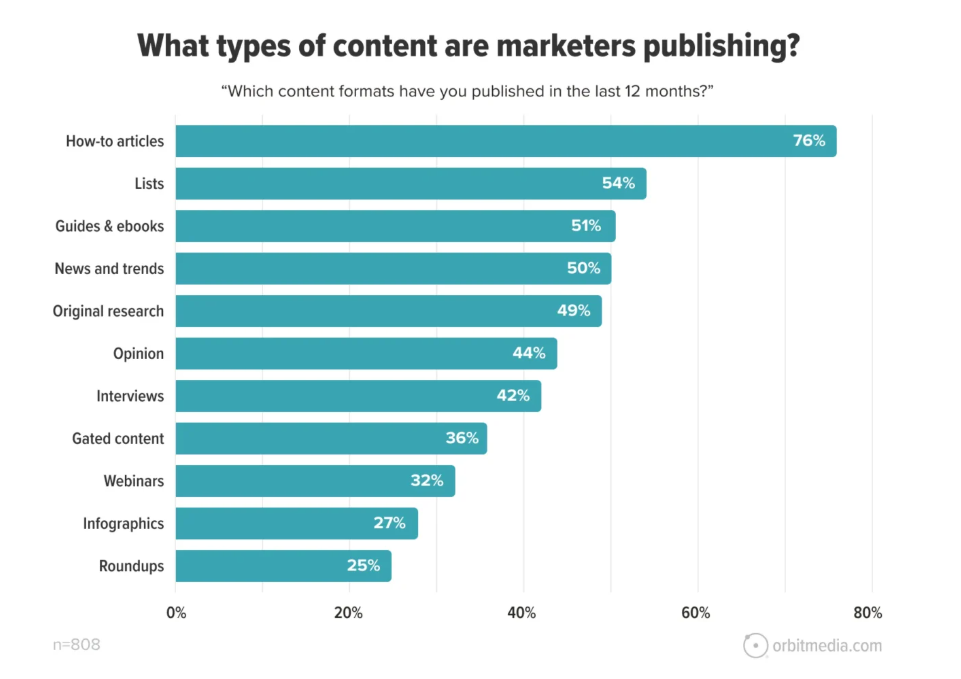
‘How-to’ articles have a clear lead, with 76% of blog writers saying they’ve published at least one in the last 12 months. ‘How-tos’ are easy to put together.
They rely largely on knowledge that you (or your writer) already have about the company, product, or service. But when the survey asked about the posts that performed best, ‘how-to’ articles didn’t do so well.
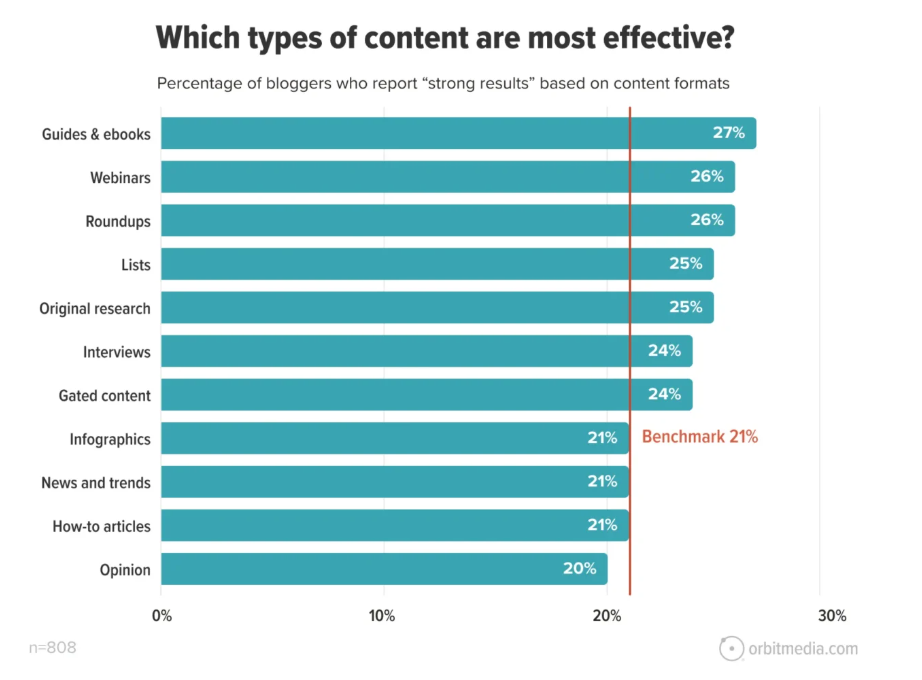
‘How-to’ articles drop all the way to the bottom, only just making the benchmark of 21%. Guides and ebooks, webinars, roundups, and list posts are leading the way when it comes to engaging readers. So what can we take away from this?
Embrace the Idea of Being More Magazine
Rose Crompton is a freelance copywriter who believes these results show the importance of mixing up your blog post styles. She says businesses should adopt a ‘be more magazine’ mindset when it comes to their business blogs.
“An issue of a magazine would be pretty dull if all of the articles inside followed the same format, or all had the same purpose,” says Rose. “Imagine picking up a magazine that was only full of listicles, or opinion pieces, or long-ass features. You’d quickly get bored with it. And the same is true of business blogs.
If you’re only publishing how-to articles or company news, you risk not catering to the needs of some of your audience segments and eventually boring the pants off even your most avid ‘how-to’ fans.
Vary the style of your articles to reach more of the people you want to attract to your site,” says Rose.
6 Blog Post Styles Every Service-Based Business Should Publish
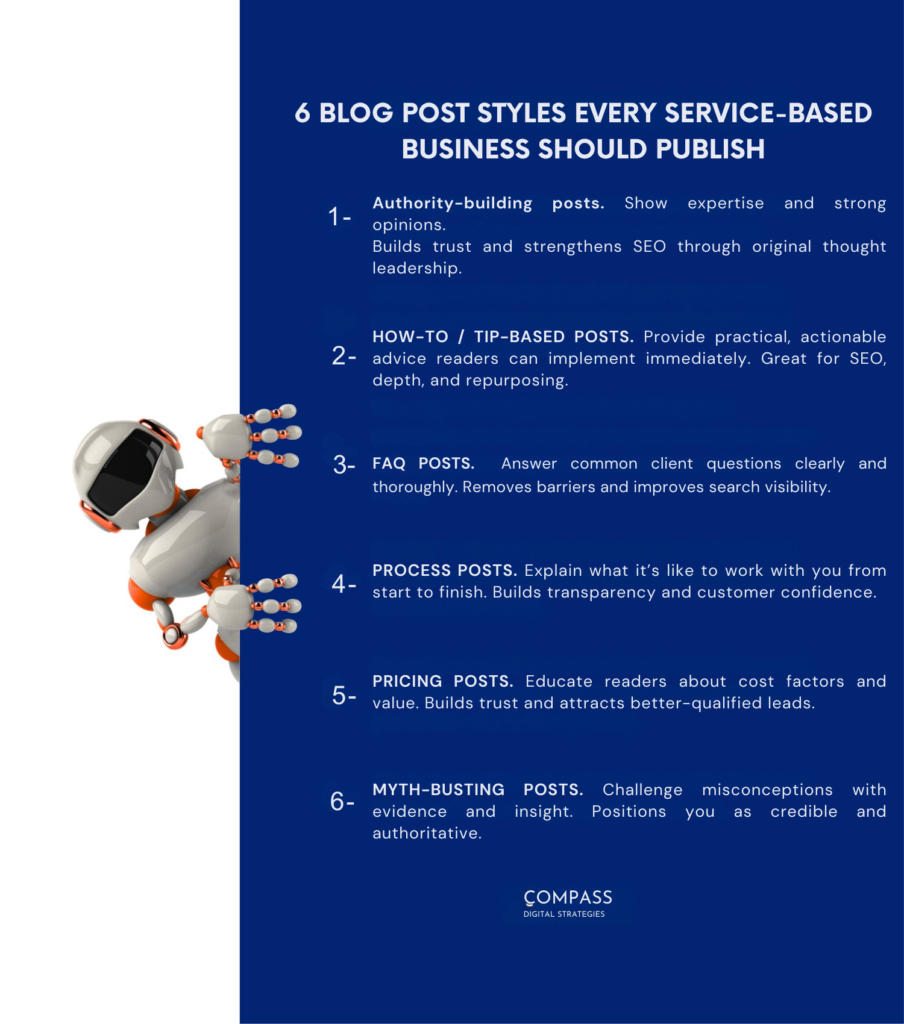
The Annual Blogger Survey offers an overview of all post styles and what’s most effective. But I think there are 6 that no service-based business should be without—either because they’re useful for SEO, or for customer engagement.
1. Authority-Building Post
Purpose: Whether it’s a roundup or an opinion piece, these articles show that you’re tuned into topics that matter and have the expertise to share a strong point of view.
Good for: SEO as it shares original, independent thought, as well as for customer experience, as people can get to know you and your company’s values.
Example post titles:
- “Why DIY [YOUR INDUSTRY] often leads to [CLIENT PAIN POINT] later”
- “The truth about choosing the right [SERVICE] and what most people overlook”
- “3 things I wish more people knew before hiring a [JOB TITLE]”
Successful authority-building posts communicate your experience. They give your voice weight and reinforce that you can be trusted.
Always acknowledge the other side of the argument in these pieces. Show that you respect diverging opinions and have knowledge and awareness across the entire topic, not only the angle and point you’re arguing for.
2. ‘How-To’ or Tip-Based Post
Purpose: These posts give your website visitors practical, easy-to-follow advice that they can implement right away. It helps people feel proactive as they search to solve a problem. How-tos and tips are also a chance to show off your knowledge and expertise.
Good for: SEO, as these posts tend to be lengthy. They’re also a great opportunity to link to other resources, such as ebooks, downloads, or other articles that naturally fit with the subject of the tips. In terms of customer experience, they give people the tools to achieve an outcome and feel productive. (With your assistance, of course.)
Example post titles:
- “3 things to fix on your [X, Y, or Z] before you even think about hiring [JOB TITLE]”
- “How to tell if your [X,Y, or z] is the reason you’re not getting [RESULT]”
- “Quick wins you can knock out in an hour to improve your [RESULT/KPI]”
These posts also generate soundbites and snippets that you can repurpose. For example, you could turn each tip into an individual social media post, or you may do a condensed version of the list to use in your email newsletter.
3. FAQ Post
Purpose: These posts have a very specific focus: to answer one frequently asked question in depth. It should help remove a barrier to people hiring you by showing you’ve got credible fixes for particular problems.
Good for: Both SEO and customer experience. The search bots will like it because you’re giving a detailed answer to a search query people commonly ask, and potential clients will like it because you’re handing them information on a plate.
Example post titles:
- “How much do your services cost?”
- “What’s the process like from start to finish?”
- “What happens if I need to pause or cancel?”
When it comes to formatting these posts, you might choose one or two FAQs on a similar theme and answer them in the one article. This will give the piece a clear focus, which Google loves. (Particularly if you make it easy to read and give a straight answer somewhere on the page.)
Alternatively, you could do a top 10 FAQ post on a particular topic and give short answers to each question, making sure you link to further resources that offer more depth. In fact, let’s see how that might work.
Extra FAQ Post Tip
If you go the FAQ mega-list route, it’s OK to only offer brief answers on that page because you’ve answered the question in more detail in another blog post. This is actually a great opportunity for internal linking.
Here’s an example in action: Answering the top 11 dental implant questions, which I worked on for a dental practice client. The post is a list of FAQs, and we linked as many answers as we could to a more detailed article on the topic.
4. My Process Posts
Purpose: Your client may be working with someone like you for the first time. These posts show transparency and confidence and reassure clients that you have a solid plan for completing the work.
Good for: These posts are more useful when it comes to creating a good customer experience, rather than being useful for SEO.
Example post titles:
- “What it’s like to work with me from start to finish”
- “Behind the scenes of a typical [SERVICE NAME] project”
- “Here’s what happens after you hit ‘submit’ on my inquiry form”
Mapping out your process is also a great way to show how you’re different from your competitors. It might be that a client reads about how you work and prefers your process over someone else’s. (Particularly when it comes to billing and payment methods. Which leads nicely onto…)
5. Pricing Posts
Purpose: To create a post that lets you talk about the money side in a way that builds trust.
Good for: SEO and customer experience because it’s an FAQ and highly searched.
Example post titles:
- “How much does [YOUR SERVICE] really cost?”
- “Why I charge what I charge and how that benefits you”
- “What impacts pricing for [INDUSTRY] (and how to know what’s worth it)”
Pricing questions are popular in almost all industries. Even if you don’t share your pricing publicly it’s still smart to educate potential clients about what influences prices within your industry and at least give a cost range.
6. Myth-Busting or Belief-Shifting Post
Purpose: Dispel common misconceptions about what you do by sharing your perspective about the problem you solve.
Good for: SEO as Google’s entire MO is provide accurate information, and opposing views often stand out. And it’s good for customer experience because you’re demonstrating your knowledge and speaking truthfully to people.
Example post titles:
- “You don’t need [COMMON MISCONCEPTION] to get [DESIRED OUTCOME]”
- “The real reason [RESULT] isn’t happening and it’s not what you think”
- “3 myths about [INDUSTRY] that could be holding you back”
These posts provide more context around a common belief. But what’s important here is that you provide evidence to back up your myth-busting claims. This could come in the form of original research, expert quotes, or using business case studies.
Meet Your Goals. Follow These Ratios
By now you understand how to link your blogging to the business goal you want to achieve. And you have some different blog post styles to help you do that. All that’s left is to marry the two up.
Let’s look specifically at how your business goals influence your blog post style ratios.
More Traffic
Load up on ‘how-to’ and quick-win tutorials that tackle the exact questions your audience is Googling. So make this about 60% of your content.
Mix in 25% opinion pieces to stand out, add 10% of tangential posts (i.e. tools, trends, or lifestyle tie-ins) for variety, and leave 5% for straight conversion content (articles about your processes, pricing, or services) to capture the new eyeballs.
More Leads in the Pipeline
Keep ‘how-tos’ at 45% to stay search-friendly, but give a solid 25% over to thought-leadership posts. Make 15% tangential topics to build rapport, and dedicate the final 15% to case studies, service spotlights, and FAQs that guide visitors toward your ‘book a call’ (or fill the form, email me, etc.) call to action.
Greater Brand Awareness Through Backlinks
People love linking to clear, well-written guides so create 35% ‘how-to’ content, making sure each post is epic. Have 25% as opinion pieces that spark quotes, and bump tangential, share-worthy resources to 30%—think about creating original research, free tools, or roundups that others will reference. Round it out with 10% conversion content.
Become a Voice of Authority
Let bold perspectives and deep dives take 50% of the editorial calendar, proving you’re the person to trust. Keep ‘how-tos’ at 30% for steady traffic, sprinkle 15% of tangential posts throughout the year, and save 5% for conversion content.
Customer or Client Retention
Let practical ‘how-tos’ lead the way, taking the lion’s share (40%) of your editorial calendar. Process, get-to-know you, and behind-the-scenes posts should take 10%—the combination will help nurture customer loyalty. Use 30% tangential content to stay relatable and finish with 10% conversion content.
An Effective Blog Knows How to Balance Its Posts

A blog backed by a solid strategy is populated with posts that provide future and existing clients with the content they’re searching for. It should deliver a mix of practical help, fresh perspectives, and the proof they need to feel confident to complete your inquiry form.
Do this consistently and the search engines will pick up on it.
Get a Solid Blog Plan in Place
Content creation can be overwhelming when you’re a service provider. When you’re trying to keep all of the business plates spinning, blogging and marketing often get bumped to the bottom of the to-do list.
Stay positive. You can do this. Particularly if you’ve got the Instant Blog Planner to hand.
This downloadable guide will help you plan your next 6 months of content. All you need is one afternoon focusing on your blog plan, and the Instant Blog Planner™ will help you map out half a year’s worth of strategic, data-backed blog topics that attract the right people.
Create a business blogging plan that helps you achieve your business goals.