Show me the blog post topics. 👇
Well hellloooo there. I’m Barb, an organic digital marketer. No, I’m not a copywriter. So who the crap am I to show up in your search results with a list of blog ideas for copywriters? After all, you’re the professional. Coming up with ideas is part of your job. So what’s so special about the 35 suggestions I’m offering?

I’ve worked with several copywriters over the years. And there have definitely been times when they’ve said, “I am so stuck with what to write about.” Or “I need ideas that are going to rank well.”
So I step up and do my SEO thing. Then they do their writing thing. And the result is a blog post people are actively searching for and want to read.
Working collaboratively in this way has led to successes like:
- 1,214 page views from 1,080 people, so prospects revisited and reread the content.
- 24 leads (form completion and submission) versus the two leads from the previous 12 months. That’s an increase of 169%.
- A 69% increase in search visibility for the primary search term and a 71% increase for the secondary search term.
Finding subjects to write about, whether for your own business or for a client, takes a lot of creative energy. To avoid burning out, it’s important to remember that it’s OK to ask for help.
So whether you’re here because
- procrastination is causing too many pauses
- you’re running out of ideas to pitch
- you just want some fresh avenues when it comes to finding blog post ideas
I’ve got you.
And if you still have doubts about how helpful someone with an SEO, non-writing background can be, let me introduce you to some of my copywriting work buddies and their copywriter friends. They’ve all kindly offered their unique professional copywriter insight for this article.
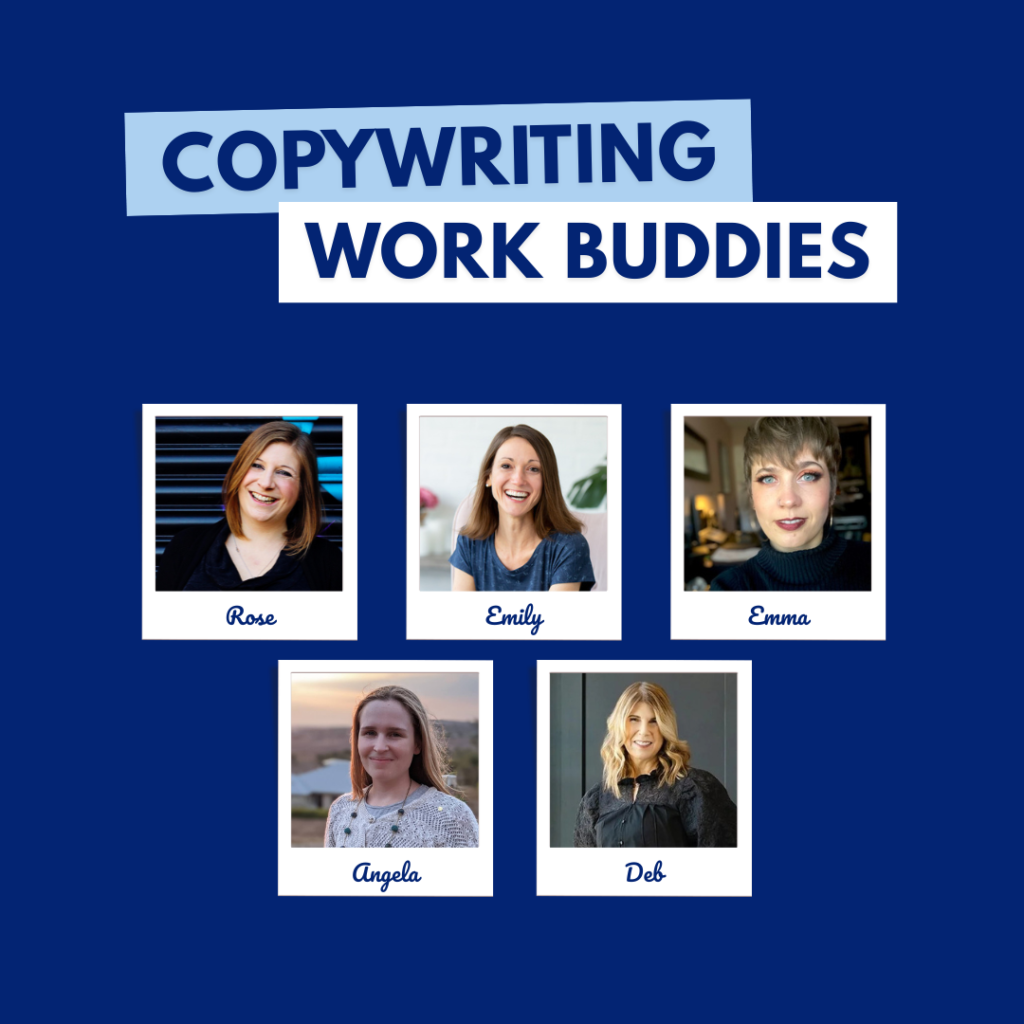
Between them, these copywriters have written thousands of blog posts. But I haven’t called them together to give you a list of possible headlines. (I’ve done that bit.) Instead, I’ve asked them to share deeper insights into how they come up with blog post ideas so you’ll never have to wrestle with a blank page again.
(A bold claim, I know. But I’ve got my sassy, confident pants on.)
Do as Your Fellow Copywriters Do
The 5 copywriters I spoke to are a mix of freelancers and in-house. And all of them have to find ideas, pitch those ideas, and research and write blog posts every month.
I asked them 2 questions.
- How do you find blog post ideas for your own blog?
- How do you find blog post ideas for your client’s blog?
As a single-owner, service-based business, I know it’s common to do things for clients you wouldn’t necessarily do for your own business. (Or you simply don’t have the time.) I felt it was important to acknowledge this.
How to Get the Most Out of This Article
The article is divided into 2 sections.
Section 1: Blog post ideas for your copywriting business, and where to find them.
Section 2: Blog post ideas for clients, and where to find more.
Also, because AI is so influential on content creation, I’ve included a short section about the pros, cons, and ethical considerations around using AI for blog ideation.
Jump to the blog post idea section that lights you up
Click your browser back button to return to this menu.
🧠 Where copywriters find their own ideas →
📍 Where copywriters find ideas for clients →
🌟 Using AI for blog post ideation →
Where Copywriters Find Ideas for Their Own Blog Posts
On a walk, lying in bed, when showering, while taking a shi… sitting on the toilet.
As a professional copywriter, you already know ideas can pop up randomly. And while this mad, sporadic approach to finding article inspiration is great, it’s also unreliable.
On the days when trips to the bathroom are proving fruitless, where are copywriters finding solid ideas?
Through Conversations With Clients and Colleagues
Angela Rodgers is the copywriter for Brisbane-based website agency The Digital Brew. She’s responsible for writing the company’s monthly blog post.
Angela finds ideas
- by pulling from her everyday, on-the-job experiences, and the conversations she has with her clients
- during project discussions with her colleague, Stuart
- by identifying gaps in her own technical knowledge, and following her curiosity.
By Blending Creative Desire With Business Aims
For freelance copywriter Emma Cownley, blogging for her own business Jot Jot Boom is a chance to be more expressive. She prefers to create content that interests her, but remains true to her business goals and ethics.
Emma finds ideas
- by allowing her process to be motivated by her own creative desires
- by making sure what she writes is in line with her brand ethos and guidelines
- by looking at her top clients and asking, “Is this idea something that would appeal to them?”
- by checking the ideas against her business aims: Will the post support my services or allow for a strong call to action?
By Playing Devil’s Advocate
Copywriter Rose Crompton enjoys stirring up conversation and debate in her blog articles by sharing strong opinions, which she finds in a few different places.
Rose finds ideas
- as a result of the conversations she has with clients and other copywriters
- by thinking about keywords and phrases she wants her website to rank for, then structuring a block of blog posts around those phrases
- by reading other copywriting and marketing blogs to find posts she disagrees with, and writing responses.
By asking, ‘What keeps clients up at night?’
Deb Mitchell is a marketing strategist and writer for interior designers. Coming up with topics for her business blog often involves stepping into her client’s frame of mind.
Deb finds ideas
- by focusing on what marketing-related topics have been on her mind the most
- by finding out what business challenges keep her clients up at night, and working out which ones she can help fix
- by choosing broad marketing subjects that can be broken down into subtopics, allowing for narrow-focus articles that still have a broad appeal.
By Following Loose Strands of Ideas and Letting Them Flourish
Similar to Emma, copywriter Emily Aborn likes to write about topics and subjects that fire her up, and that she can talk about with confidence. It’s all about delivering high-quality content for her clients.
Emily finds ideas
- by focusing on topics she feels passionate about, that are within her expertise wheelhouse, or promote something she’s offering
- by thinking about her content in themes, and finding themes that give her a range of content types for an entire month
- by focusing on SEO after she’s written the piece, checking that it will drive traffic.
Solid Blog Post Ideas for Your Copywriting Business
Now that you know how they find blog post topics for their own blogs, what are some of the common (and uncommon) themes copywriters are writing about?
What Copywriters Do and How They Work
Aim and impact – Articles that clearly explain what you do, the importance of your work, and how you achieve outcomes your clients will love. These are great for educating your audience. (Because let’s face it: a lot of business owners don’t understand what copywriting is.)
- Who writes website words?
- Who writes blogs?
- Where do I find a writer for business marketing
- What is a copywriter?
- How to hire a copywriter?
- Do I need a copywriter?
- How to brief a copywriter
- How to give your copywriter constructive feedback
- Design or copy—which do I need first?
You Can (And Should) Take This Theme a Step Further
By making it personal. Share anecdotes and tell stories that demonstrate the specific way that you work.
- My favorite places to visit when I need inspiration
- Where I escape to when procrastination hits
- [NUMBER] steps I always take to ensure project success
- The things I can’t work without
- The one gobsmacking thing my clients tell me they love about working with me
- [NUMBER] projects that almost failed
- How I organize and manage your project/several projects at once

Pricing and Payment
Aim and impact – Price guides attract the right clients and deter those who may try to lowball you or haggle over your rates. They also offer transparency.
- How much do copywriters cost?
- How much should I pay for copy?
- [YEAR] copywriting rates to guide your budget
To extend this theme, you might also write about the payment process. This could be a standalone post, or part of broader pricing topics.
- When a client should pay their copywriter
- How copywriters get paid
- The importance of paying on time
- Refunding payments – what happens to the money if the project doesn’t work out?
💡 Pricing and investment. It’s a touchy subject
I’ve worked in SEO for a long time. And price and cost inquiries always attract the most traffic. The copywriting industry is the same. The search terms ‘rates for copywriting’ and ‘copywriter fees?’ each get close to 600 hits per month (according to my SEO keyword tool). But you’d be amazed how few copywriters capitalize on this opportunity.
Screenshot for your reference
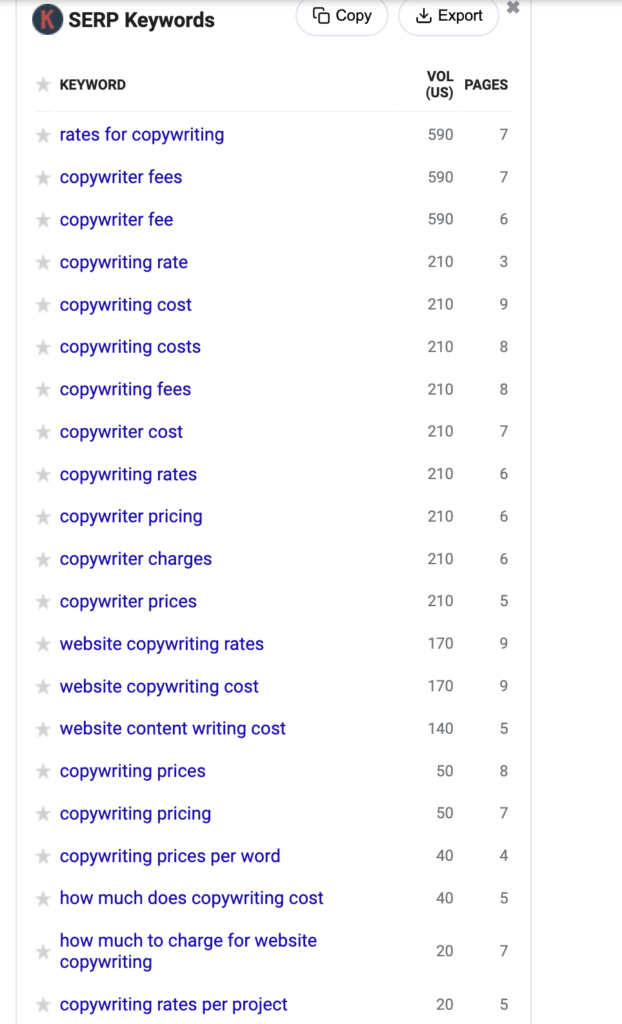
For some reason, creatives across industries get The Fear when it comes to displaying their prices.
Creative director turned freelance business coach Michael Janda has very strong views when it comes to displaying your rates.
When you post a price list it says to your potential clients, “Your business is just a cookie cutter and we have a cookie cutter solution that will work for you.”
And according to copywriter Chas Walton, one reason copywriters might fear showing their prices is due to a ‘fear of stepping out of line’ and potentially listing a price that’s out of step with the rest of the industry.
Whether you share your prices or not is your call. I’m not here to say you must, or that it’s wrong to hide your prices. But talking about it helps develop reader (aka prospective client) trust.
Here’s what I suggest.
If you don’t want to write about what you charge, at least write about how you charge, whether that’s:
- per word
- per hour
- by the project.
Explain why you do this. And, ideally, how this pricing model benefits both you and your clients. [End box out]
Copywriting and content marketing mechanics
Aim and impact – How-to guides are a useful support for business owners who are writing their own copy and managing their own content strategy.
Note: If your main target audience is people who don’t want to DIY their copywriting, it might not be worthwhile publishing too many of these posts. Instead, use these guides as an opportunity to showcase your knowledge without getting too detailed.
- How to use persuasive writing techniques in your copy
- Common copywriting mistakes
- The power of storytelling (and how it helps you sell)
- How to write a headline and hook
- Well-known copywriting frameworks that lead to conversions
- How to write a sales page
- How to write a content strategy
- How to plan your content
- How to optimize your copy
- Finding topics to write about, and managing your ideas
- Measuring copywriting/content marketing ROI
- Sales emails vs marketing emails – what the differences are, and how to write them
OK, that was the easy bit. What about blog post ideas for clients?
After all, this is where you make your money.
Where copywriters find blog topics for their clients
Finding blog post ideas for clients will depend a lot on
- the client’s industry
- how engaged and responsive the client / their team are in the content creation process
- the size of their readership, and the amount of B2C interaction between company and customer.
Here’s where the copywriters we heard from earlier are finding great ideas for their clients.
Angela from The Digital Brew
Emma from Jot Jot Boom
Rose, a freelance copywriter
Deb, a marketing strategist
Freelance copywriter, Emily
In summary, copywriters find blog post ideas for clients by
- reading trade industry publications and blogs
- talking to the client’s sales team
- reading customer reviews and interviewing customers
- looking on social media – the business’s own account, along with any their ideal customers follow
- delving into the knowledge and experiences of the company’s owner or management team
- searching on Google, using ‘also asked’ questions
- looking at competitor websites to see what they’re writing about
- finding questions customers commonly ask in emails
- delving into website SEO, and looking at posts that have historically performed well
- evaluating how a blog will fit into the broader marketing strategy
- choosing subjects that give a window into that individual business
Using AI for blog ideation
I know, I know. Using AI for copywriting is a divisive topic. But it’s every-freaking-where, so it’s hard not to talk about it. And according to the Annual Blogger Survey, it’s worth talking about.
Of the 1,000 blog writers surveyed, around 80% of blog copywriters said they use AI in one form or another.
But this post is about generating blog ideas. So what’s happening if we single out AI and blog ideation?
54% of bloggers are using AI to generate ideas.
Using AI to get (sometimes very detailed) blog topics and ideas can save time. I’ve used AI for exactly this purpose. But the results have been mixed.
Here’s an example.
I asked AI to look at a client’s website, including their existing blog content. This particular client is in the dental industry, and is continually looking for fresh ways to talk about dental implant treatment.
They have a copywriter. And over the years, that writer and I have collaborated on and published a lot of content about dental implants. I was hoping AI would find gaps and angles we hadn’t already covered.
(Gap pun very much intended, by the way.)
Going through the ideas with the client’s copywriter revealed that most of the AI’s suggestions were shallow, irrelevant, or something we’d already covered (despite entering a really specific prompt to avoid topics we’d already covered).
My conclusion on using AI for blog post ideas
Using AI-generated ideas is a useful springboard. But if you’re looking to save time on the blog ideation process, I don’t think it’s a silver bullet.
Once you’ve got the ideas, you need to evaluate each one for its relevance. You might find the idea given is a topic you’ve already covered, but just worded differently. Or that the suggestion would fit better as a short paragraph or section inside an existing blog post.
And then there are the ethical questions
AI and large language models scrape ideas from content that already exists. That’s how they work. So when you ask AI to give you ideas, it uses ideas and information ripped from other businesses and people. In some cases, it’s cannibalizing itself because it’s scraping ideas from other AI-generated content.
(Even though this Quidgest article was written a couple of years ago, it was estimated that 90% of content available on the internet will be produced with the help of AI.)
But how is this any different from what copywriters do?
Some of the copywriters we heard from earlier said they find their blog post ideas by looking at what competitors are doing. Or they read journals and media. I realize that being influenced by existing content, copy, products, services or whatever sounds similar to what AI does. But here’s the difference.
A piece of content written by a person will bring a level of originality to the work that AI can’t.
For example, a copywriter may add a personal anecdote or story. They might refer to a book, a piece of art, or some research that’s yet to be published or isn’t available online. And, just as I’ve done in this article, they can speak to other people to get their points of view on a topic.
Using AI to come up with ideas is no bad thing if used as a simple starting point. But finding ideas that excite you and your audience involves adding your own spin.
You already know the benefits of blogging. But what if I could show you the actual return you’ll get from posting?
Finding things to write about is only one part of the blog post writing process. And blog posts are only one part of your content marketing plan. (Or your client’s content marketing plan.)
To keep up the momentum on your blogging efforts, it might help to know the actual return you’ll get from blogging. And I can help with that.
The Blog PageWebsite Power-Up Plan™ delivers a clear picture of where your blog post standsentire website is right now, including your blog posts. And then it shows you what needs to be done to improve itsup your site’s visibility game. Period.
Walk away with concrete steps you can take immediately to start driving more traffic to your blog.